The classic book on the temples of ancient Israel is Menachem Haran's Temples and Temple Service in Ancient Israel. It's a little dated now, so you'll want to supplement it with recent archaeological studies that touch on sites like Arad and Kuntillet 'Ajrud -- Dever's The Lives of Ordinary People in Ancient Israel is a good one for that.
But Haran's book will get you a good overview of the Tabernacle and Solomon's Temple. It will also get you into some of the issues relating to the conflicts among different priesthoods in ancient Israel, and the composition of the Old Testament. Haran shows his real integrity and excellent when he touches on points he can't explain... for instance, that there are drinking vessels in Solomon's Temple, and no one quite knows what they're for (pp. 216-217). Kings and Chronicles don't tell us anything about it, but there was a feast of bread and wine inside Solomon's Temple.
Tuesday, January 7, 2014


Sunday, January 5, 2014
Slide Deck for January 5, 2014 Lesson
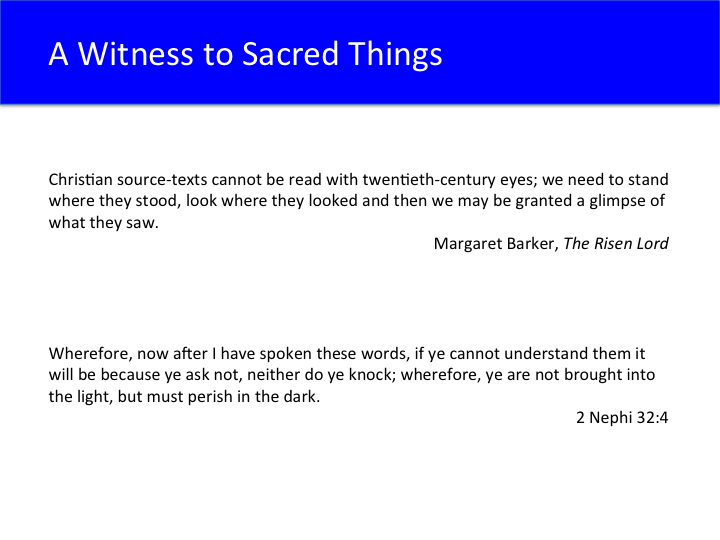
These are the slides I'm presenting in Sunday School today. Putting them into PNG format has killed the animations -- in particular, this seriously degrades slide 3. Sorry about that.




Friday, January 3, 2014
How to Read an Ancient Text
William S. Dever provides this list as the "traditional assumptions in approaching ancient texts... [:]
1. A text is a product of a particular time, place, culture, language, and it must be placed back in that context to be understood at all.
2. A text is written by an author with a specific intent, usually for a specific audience.
3. An original 'meaning' is inherent and is expressed in language that is both deliberate and potentially intelligible.
4. The reader's first task in approaching a text is to place himself and his situation in the background, attempting to be as 'objective' as possible so as to be open to the text's original (i.e., 'true') meaning in its own terms as far as possible.
5. Methodically, there is no substitute for mastery of the text's original language, geographical and cultural setting, and the light that other contemporary texts may shed.
6. Since there are, at best, always personal, subjective factors at work in interpreting an ancient text, these must be acknowledged, but they may then be usefully exploited. These factors include intuition; an educated imagination; and above all empathy, or 'positioning oneself within understanding distance.'
7. Above all, the question of the modern appropriation of the perceived meaning of the text must be kept strictly separate during the initial interpretation in fulfillment of the requirement of 'disinterestedness.'"
(William S. Dever, What Did the Biblical Writers Know and When Did They Know It?, p. 16, emphases added by me)
1. A text is a product of a particular time, place, culture, language, and it must be placed back in that context to be understood at all.
2. A text is written by an author with a specific intent, usually for a specific audience.
3. An original 'meaning' is inherent and is expressed in language that is both deliberate and potentially intelligible.
4. The reader's first task in approaching a text is to place himself and his situation in the background, attempting to be as 'objective' as possible so as to be open to the text's original (i.e., 'true') meaning in its own terms as far as possible.
5. Methodically, there is no substitute for mastery of the text's original language, geographical and cultural setting, and the light that other contemporary texts may shed.
6. Since there are, at best, always personal, subjective factors at work in interpreting an ancient text, these must be acknowledged, but they may then be usefully exploited. These factors include intuition; an educated imagination; and above all empathy, or 'positioning oneself within understanding distance.'
7. Above all, the question of the modern appropriation of the perceived meaning of the text must be kept strictly separate during the initial interpretation in fulfillment of the requirement of 'disinterestedness.'"
(William S. Dever, What Did the Biblical Writers Know and When Did They Know It?, p. 16, emphases added by me)
Thursday, January 2, 2014
Bookshelf: William S. Dever (Archaeology)
I'm going to try to post once a week a recommendation of books bearing on Old Testament study and in particular on our class. This is the first.
Archaeology has a lot to say about the history of ancient Israel; most of what it has to say is ignored by Biblical scholars, who are mostly really literary analysts, and nearly all of it is ignored by Sunday Schools. Partly, this is archaeologists' fault -- the way they generally write is even drier and more inaccessible than the output of the literary guys.
William Dever is an exception. He's punchy and readable, he sees the gap between Biblical criticism and archaeology and tries to fill it, and he knows what he's talking about. Because he's engaged in a fierce running debate with a group of dogmatic historians who claim there was no ancient Israel as we think about (he calls them "revisionists"), sometimes he takes detours into issues I don't care very much about. Still, I give all these books five stars and recommend you take a crack at one or two. In that they touch on issues relating to Deuteronomy and the editing of the Bible, the origin of the Israelites, the alteration of Israel's temple religion, and the ancient suppression of Mother in Heaven (see 1 Nephi 11 and 13), they are relevant to important themes we'll talk about in class.
In Did God Have a Wife?, Dever looks at what archaeology has to say about Mother in Heaven (my words, not his). It turns out, a lot. Israel had a female divinity, She was different from the goddesses of the nations around Israel, and there were parties in Israel who hated Her.
In Who Were the Early Israelites and Where Did They Come From?, Dever examines Israel's origins. The archaeological record gives us reason to be skeptical about some aspects of Israel's origin story (in Exodus and Joshua in particular), but confirms other aspects, including the likelihood that a "House of Joseph" group was part of Israel's ancestry and brought with it Egyptian knowledge and traditions (see, ahem, the Book of Mormon).
Others: What Did the Biblical Writers Know and When Did They Know It? is also good, though it gets more than the others into Dever's debate with the revisionists. The Lives of Ordinary People in Ancient Israel is another of his, and also excellent.
Archaeology has a lot to say about the history of ancient Israel; most of what it has to say is ignored by Biblical scholars, who are mostly really literary analysts, and nearly all of it is ignored by Sunday Schools. Partly, this is archaeologists' fault -- the way they generally write is even drier and more inaccessible than the output of the literary guys.
William Dever is an exception. He's punchy and readable, he sees the gap between Biblical criticism and archaeology and tries to fill it, and he knows what he's talking about. Because he's engaged in a fierce running debate with a group of dogmatic historians who claim there was no ancient Israel as we think about (he calls them "revisionists"), sometimes he takes detours into issues I don't care very much about. Still, I give all these books five stars and recommend you take a crack at one or two. In that they touch on issues relating to Deuteronomy and the editing of the Bible, the origin of the Israelites, the alteration of Israel's temple religion, and the ancient suppression of Mother in Heaven (see 1 Nephi 11 and 13), they are relevant to important themes we'll talk about in class.
In Did God Have a Wife?, Dever looks at what archaeology has to say about Mother in Heaven (my words, not his). It turns out, a lot. Israel had a female divinity, She was different from the goddesses of the nations around Israel, and there were parties in Israel who hated Her.
In Who Were the Early Israelites and Where Did They Come From?, Dever examines Israel's origins. The archaeological record gives us reason to be skeptical about some aspects of Israel's origin story (in Exodus and Joshua in particular), but confirms other aspects, including the likelihood that a "House of Joseph" group was part of Israel's ancestry and brought with it Egyptian knowledge and traditions (see, ahem, the Book of Mormon).
Others: What Did the Biblical Writers Know and When Did They Know It? is also good, though it gets more than the others into Dever's debate with the revisionists. The Lives of Ordinary People in Ancient Israel is another of his, and also excellent.
Sunday, December 29, 2013
Welcome, Cascade Fourth!
It's Sunday night, December 29th. A week from today I'll teach Gospel Doctrine for the first time, so I'm posting this as an inauguration of sorts, a mile marker. Posts prior to this one were put up when the blog served different purposes. Posts after this one are intended for Gospel Doctrine class members (2014 subject: Old Testament).
Saturday, March 16, 2013
Thou Shalt Go Before
Zacharias again tells us the role of the Elias priest, a role his son will fulfill. The Elias priest goes before the Lord to prepare the way, gives knowledge of (announces) salvation, which is the imminent dawn, which will give to those in the valley of the shadow of death. Finally, Elias will set the feet of those people in the path of "peace." In this description, Zacharias quotes from Worship of the Shalems texts: Isaiah 9 and Isaiah 40.
Luke, like Matthew, is a temple man and a follower of Isaiah.
Luke, like Matthew, is a temple man and a follower of Isaiah.
Friday, March 15, 2013
My Soul Doth Magnify the Lord
The Threshingfloor Marriage continues with a hymn. The "blessed" status of the "handmaid" is noted again, as is the power "might" of the Lord, and the manifestation of blessing in "seed." Notice the Sermon on the Mount Ordinance motifs: the Lord shows his arm, fills the hungry, exalts the low, and grants mercy.
Subscribe to:
Posts (Atom)