I suggested earlier that various texts use the word 'sign' or 'mark' (Hebrew 'ot or Greek semeion) to refer to priests (specifically, Genesis 1, Genesis 4, and Isaiah 8). Now Genesis 9 give us an interesting test, where it identifies the 'token' (again, 'ot and semeion -- the English translation is different, but the Hebrew and Greek are the same term as the other texts) of the eternal covenant (brit 'olam), as a bow set in the clouds. A rainbow.
Cloud imagery is common of texts set inside the temple: for starters, the Mount of Transfiguration, Daniel 7, and Lehi's dream. This reflects the incense altar that was set in the hekal, the middle room of Solomon's Temple. But are there any texts that corroborate the idea that a rainbow might refer to a priestly figure?
Turns out there's at least one. Chapter 50 of Sirach, a book preserved in the LXX but not the MT, shows the coming forth of a priest named Simon son of Onias in a temple setting (scholars think on the Day of Atonement). Verses 5-7 read like this: "...how he was glorified as he spun around the shrine, as he exited from the house of the veil. Like a morning star in the midst of a cloud, like the full moon in the days of a feast, like the sun shining on the shrine of the most high, like the rainbow gleaming in clouds of glory..."
We have: the specified location in the temple; clouds; comparison of the priest with astral bodies, like 1 Nephi 1 (stars = angels = priests); and the identification of the priest with the rainbow.
So I think the message of Genesis 9 is not that as long as you see rainbows, God won't flood the earth, but when rainbows cease, we might be in trouble (this was the folklore I knew as a kid, and believe me, I looked for rainbows with great anxiety). I think the message of Genesis 9 is that the sign, 'ot, of the eternal covenant, is that the Lord appears to his people in the temple. In ordinances, he does this in the person of his authorized messenger, the Melchizedek priest.
Thursday, January 16, 2014


Monday, January 13, 2014
Bookshelf: The Septuagint
The ancient Greek translation of the Old Testament is important. Since it's likely to come up in class and will definitely come up in your study, I want to make sure you know a few things about it, and point you to where you can find an English version.
It's called the Septuagint (sep-TOO-uh-jint), from the Greek word for "seventy," and is therefore also identified by the Roman numeral for 70: LXX. The number 70 is an old Hebrew stereotype meaning the whole world, or sometimes the world outside Israel (the idea being that there are seventy nations). You can see this idea in both the Old Testament and the New. The LXX is the earliest known translation of the Old Testament into another language -- some parts of it are pre-Jesus, even as early as 200 B.C.
The really interesting thing about this old Greek translation is that it's often very different from the Hebrew, in two ways: First, it contains books or parts of books that aren't preserved in Hebrew, but were considered by the ancient Jewish translators part of scripture (for instance, the Wisdom of Jesus Ben Sirach or the extra chapters of Daniel and Jeremiah).
Second, the LXX contains some very different readings from the traditional Hebrew text of the Bible (the Masoretic text, or MT). For instance, Deuteronomy 32:8 in the MT says that God divided the world up according to the sons of Israel, but in the LXX the same verse says that God divided the world according to the sons of God... these are radically different ideas.
To really come to grips with the differences between the LXX and the MT and why they matter, you'll need some Greek and Hebrew (there's my little pitch, again). But for starters, you can find the New English Translation of the Septuagint in its entirety online, here (I know, the web-page looks a little hokey, but the LXX translation itself is good, and downloadable in .pdf). You can also buy a physical copy of the book.
It's called the Septuagint (sep-TOO-uh-jint), from the Greek word for "seventy," and is therefore also identified by the Roman numeral for 70: LXX. The number 70 is an old Hebrew stereotype meaning the whole world, or sometimes the world outside Israel (the idea being that there are seventy nations). You can see this idea in both the Old Testament and the New. The LXX is the earliest known translation of the Old Testament into another language -- some parts of it are pre-Jesus, even as early as 200 B.C.
The really interesting thing about this old Greek translation is that it's often very different from the Hebrew, in two ways: First, it contains books or parts of books that aren't preserved in Hebrew, but were considered by the ancient Jewish translators part of scripture (for instance, the Wisdom of Jesus Ben Sirach or the extra chapters of Daniel and Jeremiah).
Second, the LXX contains some very different readings from the traditional Hebrew text of the Bible (the Masoretic text, or MT). For instance, Deuteronomy 32:8 in the MT says that God divided the world up according to the sons of Israel, but in the LXX the same verse says that God divided the world according to the sons of God... these are radically different ideas.
To really come to grips with the differences between the LXX and the MT and why they matter, you'll need some Greek and Hebrew (there's my little pitch, again). But for starters, you can find the New English Translation of the Septuagint in its entirety online, here (I know, the web-page looks a little hokey, but the LXX translation itself is good, and downloadable in .pdf). You can also buy a physical copy of the book.
Friday, January 10, 2014
Before the Flood
I'm doing my OT reading this year out of the Hebrew and Greek versions of the OT, side by side. This is a large undertaking for me, which involves getting up early and committing real time, but so far I'm on track. The immediate fruit has been to see that the vocabulary in the first seven chapters of the OT is heavy in terms that have priestly and temple significance, even if that doesn't always come through in translation. There's way too much to capture in this blog, but let me throw just out a few points:
- The ritual actions in Genesis 3 are unmistakable, but maybe we haven't thought all the way through them. For one thing, the garment of 'skin' in Genesis 3:21 is a garment of 'or in Hebrew, spelled 'ayin-vav-resh (the names of the three Hebrew letters in the word). Well, 'or, spelled aleph-vav-resh, means 'light.' These two words are pronounced identically in modern Hebrew, and have always been pronounced very similarly. God clothes Eve and Adam in garments of light. In verse 22, "Yahweh of the Gods" pronounces that "Man has become like one of us."
- In the same segment, Adam is cursed that he will eat his bread by the sweat of his brow. Eating bread and being dressed by God are both temple ritual actions, and connected in the Sermon on the Mount (more about this in the next class, for those of you who don't already know what I'm talking about). This suggests that the curse is the sweat, not the bread part. Similarly, it suggests that childbirth is not a curse -- the curse is the sorrow. If anything, the implication is that childbirth, at least in some circumstances, is a sacred act.
- Adam is commanded to 'work' ('avad in Hebrew) and 'keep' (shamar) the Garden. These are temple-priestly verbs -- 'avad means to perform ordinances, and shamar means to keep covenants. It is very striking, then, that the same words reappear in the story of Cain. Cain, first of all, is given to Eve by the Lord (like Samuel and Jesus), punning on the sound of the name 'Cain' in Hebrew (Hebrew prophets, including Nephi, thrive on puns and wordplay). In Hebrew, Cain is an 'oved of the earth -- not a 'tiller,' but a 'worker,' using the same word that means 'perform ordinances.' Interestingly, his brother Abel is a shepherd, a common image for priests and kings. In terms of vocabulary, the story we're told here is about a rivalry between two priests. After Cain kills Abel, he justifies himself by asking 'am I my brother's keeper?', where 'keeper' is shomer. Cain is an 'oved, a temple priest, but he does not shamar, keep his covenants.
- After this incident, God marks Cain with a 'sign' ('ot in Hebrew). Elsewhere, the heavenly bodies are said to be or provide an 'ot. So are the Virgin and her sons. Here's another piece of vocabulary for understanding the Visionary Men: stars = angels = priests. Nephi knows this vocabulary. Cain is a priest who falls from his station, but who still should not be killed, because of his priestly status.
Keep up the study!
Tuesday, January 7, 2014
Bookshelf: Menachem Haran
The classic book on the temples of ancient Israel is Menachem Haran's Temples and Temple Service in Ancient Israel. It's a little dated now, so you'll want to supplement it with recent archaeological studies that touch on sites like Arad and Kuntillet 'Ajrud -- Dever's The Lives of Ordinary People in Ancient Israel is a good one for that.
But Haran's book will get you a good overview of the Tabernacle and Solomon's Temple. It will also get you into some of the issues relating to the conflicts among different priesthoods in ancient Israel, and the composition of the Old Testament. Haran shows his real integrity and excellent when he touches on points he can't explain... for instance, that there are drinking vessels in Solomon's Temple, and no one quite knows what they're for (pp. 216-217). Kings and Chronicles don't tell us anything about it, but there was a feast of bread and wine inside Solomon's Temple.
But Haran's book will get you a good overview of the Tabernacle and Solomon's Temple. It will also get you into some of the issues relating to the conflicts among different priesthoods in ancient Israel, and the composition of the Old Testament. Haran shows his real integrity and excellent when he touches on points he can't explain... for instance, that there are drinking vessels in Solomon's Temple, and no one quite knows what they're for (pp. 216-217). Kings and Chronicles don't tell us anything about it, but there was a feast of bread and wine inside Solomon's Temple.
Sunday, January 5, 2014
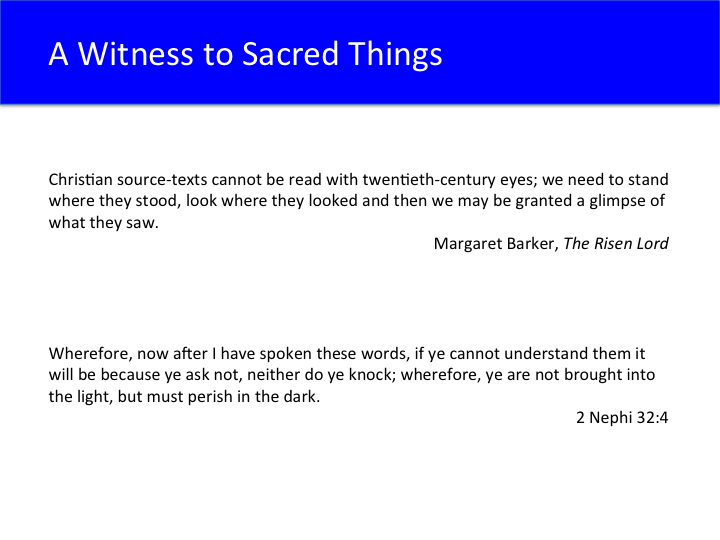
Slide Deck for January 5, 2014 Lesson
These are the slides I'm presenting in Sunday School today. Putting them into PNG format has killed the animations -- in particular, this seriously degrades slide 3. Sorry about that.




Friday, January 3, 2014
How to Read an Ancient Text
William S. Dever provides this list as the "traditional assumptions in approaching ancient texts... [:]
1. A text is a product of a particular time, place, culture, language, and it must be placed back in that context to be understood at all.
2. A text is written by an author with a specific intent, usually for a specific audience.
3. An original 'meaning' is inherent and is expressed in language that is both deliberate and potentially intelligible.
4. The reader's first task in approaching a text is to place himself and his situation in the background, attempting to be as 'objective' as possible so as to be open to the text's original (i.e., 'true') meaning in its own terms as far as possible.
5. Methodically, there is no substitute for mastery of the text's original language, geographical and cultural setting, and the light that other contemporary texts may shed.
6. Since there are, at best, always personal, subjective factors at work in interpreting an ancient text, these must be acknowledged, but they may then be usefully exploited. These factors include intuition; an educated imagination; and above all empathy, or 'positioning oneself within understanding distance.'
7. Above all, the question of the modern appropriation of the perceived meaning of the text must be kept strictly separate during the initial interpretation in fulfillment of the requirement of 'disinterestedness.'"
(William S. Dever, What Did the Biblical Writers Know and When Did They Know It?, p. 16, emphases added by me)
1. A text is a product of a particular time, place, culture, language, and it must be placed back in that context to be understood at all.
2. A text is written by an author with a specific intent, usually for a specific audience.
3. An original 'meaning' is inherent and is expressed in language that is both deliberate and potentially intelligible.
4. The reader's first task in approaching a text is to place himself and his situation in the background, attempting to be as 'objective' as possible so as to be open to the text's original (i.e., 'true') meaning in its own terms as far as possible.
5. Methodically, there is no substitute for mastery of the text's original language, geographical and cultural setting, and the light that other contemporary texts may shed.
6. Since there are, at best, always personal, subjective factors at work in interpreting an ancient text, these must be acknowledged, but they may then be usefully exploited. These factors include intuition; an educated imagination; and above all empathy, or 'positioning oneself within understanding distance.'
7. Above all, the question of the modern appropriation of the perceived meaning of the text must be kept strictly separate during the initial interpretation in fulfillment of the requirement of 'disinterestedness.'"
(William S. Dever, What Did the Biblical Writers Know and When Did They Know It?, p. 16, emphases added by me)
Thursday, January 2, 2014
Bookshelf: William S. Dever (Archaeology)
I'm going to try to post once a week a recommendation of books bearing on Old Testament study and in particular on our class. This is the first.
Archaeology has a lot to say about the history of ancient Israel; most of what it has to say is ignored by Biblical scholars, who are mostly really literary analysts, and nearly all of it is ignored by Sunday Schools. Partly, this is archaeologists' fault -- the way they generally write is even drier and more inaccessible than the output of the literary guys.
William Dever is an exception. He's punchy and readable, he sees the gap between Biblical criticism and archaeology and tries to fill it, and he knows what he's talking about. Because he's engaged in a fierce running debate with a group of dogmatic historians who claim there was no ancient Israel as we think about (he calls them "revisionists"), sometimes he takes detours into issues I don't care very much about. Still, I give all these books five stars and recommend you take a crack at one or two. In that they touch on issues relating to Deuteronomy and the editing of the Bible, the origin of the Israelites, the alteration of Israel's temple religion, and the ancient suppression of Mother in Heaven (see 1 Nephi 11 and 13), they are relevant to important themes we'll talk about in class.
In Did God Have a Wife?, Dever looks at what archaeology has to say about Mother in Heaven (my words, not his). It turns out, a lot. Israel had a female divinity, She was different from the goddesses of the nations around Israel, and there were parties in Israel who hated Her.
In Who Were the Early Israelites and Where Did They Come From?, Dever examines Israel's origins. The archaeological record gives us reason to be skeptical about some aspects of Israel's origin story (in Exodus and Joshua in particular), but confirms other aspects, including the likelihood that a "House of Joseph" group was part of Israel's ancestry and brought with it Egyptian knowledge and traditions (see, ahem, the Book of Mormon).
Others: What Did the Biblical Writers Know and When Did They Know It? is also good, though it gets more than the others into Dever's debate with the revisionists. The Lives of Ordinary People in Ancient Israel is another of his, and also excellent.
Archaeology has a lot to say about the history of ancient Israel; most of what it has to say is ignored by Biblical scholars, who are mostly really literary analysts, and nearly all of it is ignored by Sunday Schools. Partly, this is archaeologists' fault -- the way they generally write is even drier and more inaccessible than the output of the literary guys.
William Dever is an exception. He's punchy and readable, he sees the gap between Biblical criticism and archaeology and tries to fill it, and he knows what he's talking about. Because he's engaged in a fierce running debate with a group of dogmatic historians who claim there was no ancient Israel as we think about (he calls them "revisionists"), sometimes he takes detours into issues I don't care very much about. Still, I give all these books five stars and recommend you take a crack at one or two. In that they touch on issues relating to Deuteronomy and the editing of the Bible, the origin of the Israelites, the alteration of Israel's temple religion, and the ancient suppression of Mother in Heaven (see 1 Nephi 11 and 13), they are relevant to important themes we'll talk about in class.
In Did God Have a Wife?, Dever looks at what archaeology has to say about Mother in Heaven (my words, not his). It turns out, a lot. Israel had a female divinity, She was different from the goddesses of the nations around Israel, and there were parties in Israel who hated Her.
In Who Were the Early Israelites and Where Did They Come From?, Dever examines Israel's origins. The archaeological record gives us reason to be skeptical about some aspects of Israel's origin story (in Exodus and Joshua in particular), but confirms other aspects, including the likelihood that a "House of Joseph" group was part of Israel's ancestry and brought with it Egyptian knowledge and traditions (see, ahem, the Book of Mormon).
Others: What Did the Biblical Writers Know and When Did They Know It? is also good, though it gets more than the others into Dever's debate with the revisionists. The Lives of Ordinary People in Ancient Israel is another of his, and also excellent.
Subscribe to:
Posts (Atom)