Showing posts with label Margaret Barker. Show all posts

Thursday, April 17, 2014

Bookshelf: the Divine Woman

Here are some excellent books on the subject of Israel's Divine Woman.  Shame that none of them are written by Mormons.

There are many others on the subject; these are just the books that happen to be in my library.

These are not fringe voices or fringe ideas.  Mainstream biblical scholarship (by which I mean scholarship not tied to seminaries, and specifically scholarship that is not Evangelical), in part because of the force of archaeological evidence, is increasingly accepting the idea that Israel knew a divine mother as well as a divine father.

This should not surprise us.  We have Nephi and Eliza R. Snow.

Thursday, March 6, 2014

Bookshelf: 1 Enoch

If you're going to get into the extra-biblical books, 1 Enoch is the place to start.  This book was held to be scripture by lots of ancient Christians -- including Jude, who quotes from it -- and by Ethiopian Christians to this day.

If you don't want to get 1 Enoch (it's called 1 Enoch because there are a 2 Enoch and a 3 Enoch; 1 Enoch is also the Ethiopic Apocalypse of Enoch) in a big anthology, there's a recent standalone translation by George Nickelsburg and JamesVanderKam.  The same guys also have a two volume (one and two) commentary on 1 Enoch, well worth the read.

Margaret Barker's first two books, The Older Testament and The Lost Prophet, are about how the earliest Christians new a different Old Testament than we have today... an Old Testament that included, among other things, 1 Enoch.  More about Margaret later.

Tuesday, February 25, 2014

The Lady Under the Tree

One of Israel's great heroes from the time of the judges is Deborah.  She's a prophetess, and she dwells under a tree.  The KJV also says she's the "wife of Lapidoth," but that may be a mistranslation.  As Methodist scholar Margaret Barker has pointed out (Margaret will merit her own bookshelf entries at some point, for sure), "Lapidoth" nowhere else appears as a man's name, and it doesn't look like a man's name -- it looks like a feminine plural, meaning "torches" or "flashing lights.  This makes Deborah the prophetess, the "woman of flashing lights," who dwells under a tree.  All of this is really, really interesting.

It turns out there's another Deborah, and I, at least, had totally forgotten her.  She only appears in one verse in the Bible, when she dies.  We're told three things about her:

  1. She is Rachel's wetnurse (and since Benjamin isn't born yet, this can only mean that she nursed Joseph, which ties her to the royal lineage of the northern kingdom and also to the ancestry of the Book of Mormon prophets).
  2. She is buried under a tree (in the LXX, she dies under the tree -- very slight difference), in an event so important the tree merits a name... it's a special tree.  
  3. Her name is Deborah.  This name is interesting, because it's the Hebrew word for "honey-bee."  Here we get into a whole bunch of old and interesting associations, including the titles of Pharaoh (one of which, nswt-bjtj, means "he of the sedge and the bee"), the story of Joseph and Asenath (Joseph's bride is covered with honey bees... scroll down to chapter 16) and the packing priorities of the Jaredites.
All this looks to me like one of the ancient symbols of Israel's divine woman (along with the sacred tree, the tree of life) was the honey bee.

Sunday, January 5, 2014

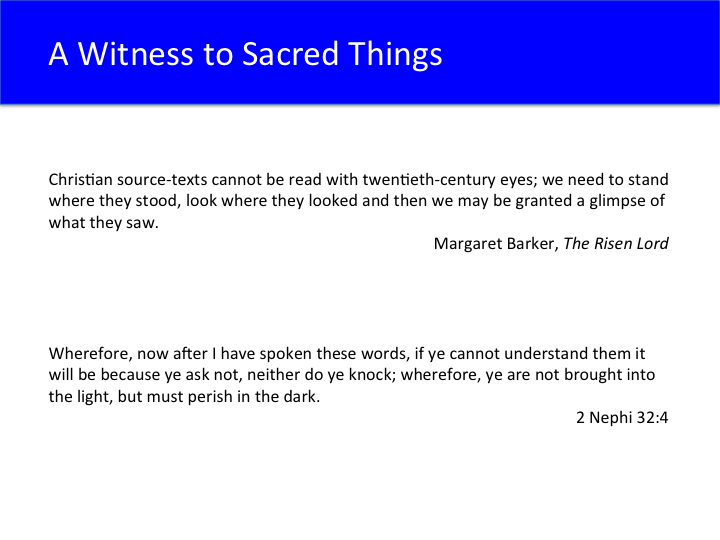
Slide Deck for January 5, 2014 Lesson

These are the slides I'm presenting in Sunday School today.  Putting them into PNG format has killed the animations -- in particular, this seriously degrades slide 3.  Sorry about that.